Remember this music video, in which New York city is imagined as spinning record on a turntable? The Empire State at the center, anchoring the spinning city, the steadiness of the needle’s shadow. Lauryn’s movement is classic New York: a woman on foot in elevated shoes–sometimes it seems/we’ll touch that dream.

“Change will come eventually.”

The city is accessible just by going out and walking it, all the parts are connected. New York is the spinning record, and sometimes we get scratched.

this is a continuation of an earlier interview

ArchivingtheCity: I’m talking to people about their practice; people who I think of loosely as having any kind of archival practice, and who are connected to or interested in the experience of living in cities. I want to find out about their “process.” So we can talk about some your projects that I saw on your website—

Hakan Topal: Do you want me to talk about the collective first, a little bit?

A: Sure!

H: We started this collective when I first moved to New York, from Ankara. I had a very close friend and we were doing these projects together, traveling to different sites in Turkey doing photography. And I collaborated with him on multiple projects prior to the collective. Actually, he was my kind of mentor, my professor, at one point. And so when I moved to New York, we were discussing and exchanging things online, and then we said why don’t we establish a kind of a platform to work together? You know, like very loosely? Then [at the same time] things in Turkey started to happen, like it always happens, but for us it was a kind of turning point. One of them was the 1999 earthquake. I feel lots of similarities between [the earthquake and] what happened in New Orleans with [Hurricane] Katrina. It betrayed the very condition of the state apparatus. Although the state collects all this money, and claims that it provides security for people, when the time comes that people really need help, the state is not there.

(more…)

Tel Aviv July, 2009

Neve Tzedek and Florentine are unlike many other parts of the city, in that the walls of these neighborhoods are covered in all kinds of “writing.” Ranging from graffiti to street art, posters and flyers, this writing screams and whispers for the attention of passers-by.

Reading walls while walking both requires and trains a sense of the city that is difficult to get by perusing the statistics of the planning department, or attending community meetings. The discourse on the walls is of a different character—a kind of ubiquitous white noise, noticeable in an otherwise clean, “white” city. Let’s take up the task of reading while walking this city. Because the writings on the walls, and the experience of reading them, provide a complex commentary upon the ongoing physical, economic and political transformations faced by Tel Aviv-Jaffa.

Dance is unlike any other social medium. It’s the core of our culture.

–Stanley Kirk Burrell, aka. MC Hammer

Art flies around truth, but with the definite intention of not getting burnt. Its capacity lies in finding in the dark void a place where the beam of light can be intensely caught, without this having been perceptible before.

Franz Kafka, The Blue Octavo Notebooks

The Real Revolution Is Love,

I argue with Roberto on the slick-tiled patio
where houseplants as big as elms sway in a samba
breeze at four or five in the Managua morning
after too many Yerbabuenas and as many shots of
golden rum. And watch Pedro follow Diane up
her brown arm, over the shoulder of her cool dress,
the valleys of her neck to the place inside her
ear where he isn’t speaking revolution. And Alonzo
tosses in the rhetoric made of too much rum and
the burden of being an American in a country
he no longer belongs to.

What we are dealing with here are ideological
differences, political power,
he says to
impress a woman who is gorgeously intelligent
and who reminds me of the soft talc desert
of my lover’s cheek. She doesn’t believe
anything but the language of damp earth
beneath a banana tree at noon, and will soon
disappear in the screen of rum, with a man
who keeps his political secrets to himself
in favor of love.

I argue with Roberto, and laugh across the
continent to Diane, who is on the other side
of the flat, round table whose surface ships
would fall off if they sailed to the other
side. We are Anishabe and Creek. We have wars
of our own.
Knowing this we laugh and laugh,
until she disappears into the poinsettia forest
with Pedro, who is still arriving from Puerto Rico.

Palm trees flutter in smoldering tongues.
I can look through the houses, the wind, and hear
Jennifer’s quick laughter become a train
that has no name. Columbus doesn’t leave the
bow of the slippery ship, and Allen is standing at the rim
of Momotombo, looking into the blue, sad rain
of a boy’s eyes. They will come back tomorrow.

This is the land of revolution. You can do anything
you want,
Roberto tries to persuade me. I fight my way
through the cloud of rum and laughter, through the lines
of Spanish and spirits of the recently dead whose elbows
rustle the palm leaves. It is almost dawn and we are still
a long way from morning, but never far enough
to get away.

I do what I want, and I take my revolution to bed with
me, alone. And awake in a story told by my ancestors
when they spoke a version of the very beginning,
of how so long ago we climbed the backbone of these
tortuous Americas. I listen to the splash of the Atlantic
and Pacific and see Columbus land once more,
over and over again.

This is not a foreign country, but the land of our dreams.

I listen to the gunfire we cannot hear, and begin
this journey with the light of knowing
the root of my own furious love.

by Joy Harjo, from In Mad Love and War.

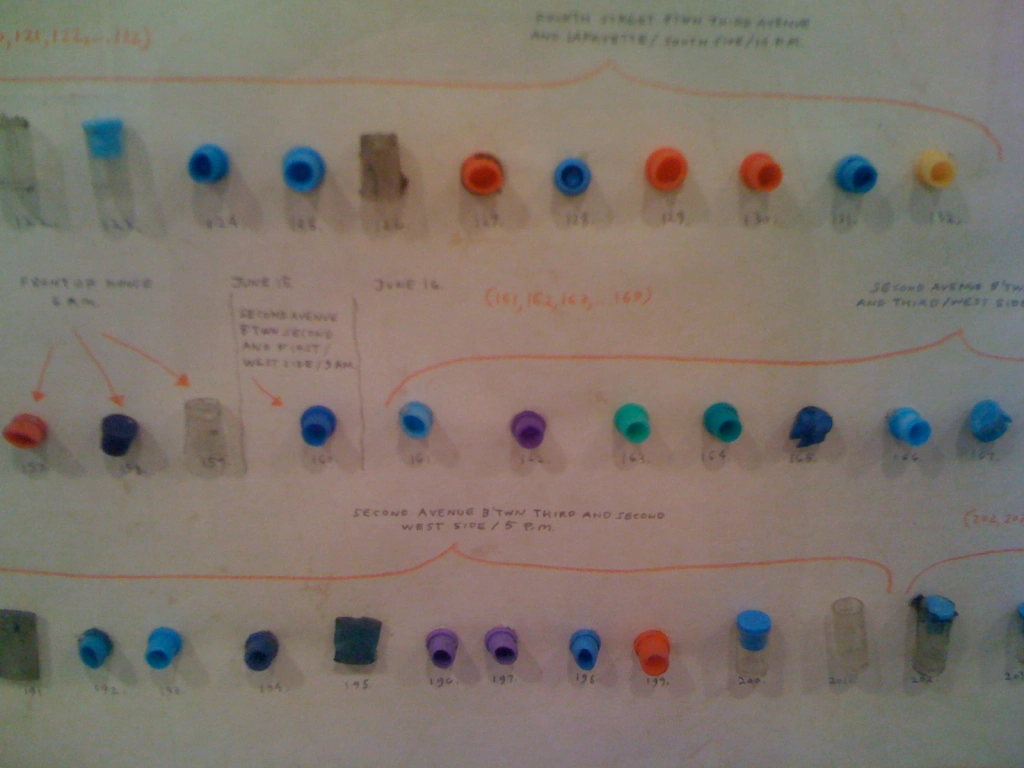
tools of hakan's trades

On Monday, June 28th I had a great conversation with Hakan Topal, member of xurban_collective and doctoral student in Sociology at the New School for Social Research, here in New York. Hakan is from Ankara, Turkey, and was an engineer in a former life. He is an artist and a researcher. A research artist?

This conversation reminded me of how important it is to keep speaking with people we admire, who share our struggles with life and work, and who are dedicated to finding creative ways to move in the world.

Here is one part of our conversation, with many more to come.

Hakan asks the first question.

H: So what are you doing this research for? For your thesis? For the magazine? Or both?

A: I got stuck a while ago because I realized I wanted to do something that was not exactly social science, even though I’m in a social science degree program. So that became a problem, right? And then I decided that one way to kind of like loosen up would be to keep a blog about things I like.

H: Right…

A:So I started doing that, and actually it’s been really helpful, because I can just have an idea, or a thought, or see a fashion spread that I like, or whatever, and everything can just go into the blog—

H: Mm hmm

A: I don’t have to think about organizing it into chapters, and stuff—

H: Yes, perfect, yes…

A: And since I’m interested in what I’m calling “archival practice,” which is different than just what we traditionally think of as archival research, the website is actually a good archival practice for me—at least a good way to think of archives, in practice. And now, I’ve come to realize that I can’t really think or read or write outside of blog format anymore…

H: Yeah, wow! [laughs]

A: Yeah I can’t read [academic] JSTOR articles anymore. I can’t read monographs, much less write one. So I started to realize my work has to be about this process—

H: Mm hmm, mm hmm…

A:  About how I can’t do it anymore, but I still want to do “it.”

H:Right. [The blog] is forcing you to write something, even though it’s scattered—forcing you to concentrate on bits and pieces.

A: Exactly

H: And once you sit down, you can combine them into something.

A: Yes, that’s the thing: finding the form.

More to come about Hakan’s work and methods!

For a long time the word “house” referred not to a particular style of music so much as to an attitude. If a song was “house” it was music from a cool club, it was underground, it was something you’d never hear on the radio. In Chicago the right club would be “house,” and if you went there, you’d be house and so would your friends. Walking down Michigan Avenue, you would be able to tell who was house and who wasn’t by what they were wearing. If their tape player was rocking The Gap Band, they were definitely not house, but if it was playing Loleatta Holloway or (surprisingly enough) the Eurythmics, they were and you would probably go over and talk to them.


One day soon, Chicago [black, gay] kids would invent a stark new kind of dance music, and because of where this came from [The Warehouse], and because of where it was played, it would steal the name for itself. But for several years, house was a feeling, a rebellious musical taste, a way of declaring yourself in the know. Certainly the word house was used long before people started making what we would now call house music.

–Bill Brewster & Frank Broughton, Last Night a DJ Saved My Life: The History of the Disc Jockey, (1999)

But, where does house music begin?

(more…)

I need sticky things. Ideas that are flexible, malleable, with plastacine qualities; things that can keep sticking to other things, that can be used to build SCULPTURES, not structures

What  is the difference between a structure and a sculpture? forms we can mold, assemble improvisationally–forms with feeling. I want to make flexible sculptures that can mold into/onto places, that can mold around corners, that can mold into the parts of the city I care about, that can become real in the world in a particular way—that can take the shape of the world.

(more…)